Showing posts with label chinese. Show all posts

Tuesday, September 22, 2009

A Bit on Homophones

It is amazing how much you learn about your own language once you start to teach it.

Simultaneously studying Chinese and teaching English has given me some great new insights on the art and science of both languages, and I have to say, it has been quite eye-opening.

One of the most interesting things I have learned is how ignorant people (myself included) are of the difficulties inherent in their own native tongue.

For example, it wasn't until this year that I realized how complex and confusing English grammar is. For the most part, it has always just been second nature for me. (As a side note, it also wasn't until this year that I learned how to to spell the word grammar!)

I also had not realized until recently, how vast and varied the choices are in the English lexicon. I have come to appreciate the beauty of our language - with so many words and their subtle shades of meaning. Choosing the perfect word for any given situation is an art that is almost impossible to teach to an ESL student.

After a long day of teaching English, am I perturbed, irritated, annoyed, vexed, disgruntled, fed up, exasperated, or simply displeased?? The choices are endless!

Recently, I did some editing for a fertility clinic's advertisement in which they claimed they could help you "breed a baby!" Of course this sounds ridiculous, but how are they to know that we only use the word breed when we're talking about farm animals!

As I am becoming more and more aware of the intricacies or language, I continuously find myself baffled by many of the things that my students say to me when we discuss the differences between Chinese and English.

One of the most common things that I hear goes something like this "English grammar is so difficult! Chinese is much easier, we don't have any grammar."

I must say, this is one of the most ridiculous things I've ever heard! It is true that Chinese grammar is simpler than English grammar, but just because there is no conjugation of verbs does not mean that the language is grammar-less!

I have been studying Chinese for the last 7 months and I can assure you that Chinese has grammar - I myself am having a heck of a time trying to master it! But no matter how much I argue with them, some will simply not let it go. Many native Chinese speakers are utterly convinced that their own language has no grammar rules!

But by far the most befuddling thing that I have heard from my students is that English is difficult because it has a lot of words that sound the same but have different meanings.

Really!? Homophones are what makes English difficult for a Chinese speaker? The Chinese language has got to be the KING of homophones, and you think homophones are the difficult part of English?! Well, to each his own I guess.

It is at this point in my lesson that I usually write the word homophone on the board and start pointing out examples like through and threw, or right and write. Then my students will start to join in with words like
  • bunch and branch
  • indivisible and invisible
  • require and inquire
  • bubble and Barbara
and my favorite
  • ambulance and excellence


Yes, the difficulties for them are not the actual homophones in the English language, but the words that almost sound the same.

On one hand I can kind of see where there coming from, but on the other hand - well I really just can't!

To understand my complete exasperation at this answer let's take a look at the Chinese language. The language has four tones, which means there are four ways to say any given syllable.

The syllable ma for instance could mean mother (first tone), horse (third tone), to scold (fourth tone) and could be a verbal question mark ma (neutral tone).

On top of having four possible ways to say one syllable, if you choose just ONE way to say one syllable, you are still left with many possible characters - each character having its own meaning.

For example the syllable bi (fourth tone), gives you 58 possible characters!!!! (比 ,必,庇 ,拂 ,泌 ,俾 ,祕 ,陛 ,埤 ,婢 ,敝,畢 ,閉 ,弼 ,愎 ,賁 ,痺 ,睥 ,辟 ,幣 ,弊 ,碧 ,裨 ,蔽 ,壁 , 斃 ,臂 ,薜 ,避 ,璧.... )

That is 58 possible words (and meanings) for ONE phonetic pronunciation
!


And homophones are difficult in English!? Not even close!!!!

But, What can I say... there is no wrong way to write your own language, right?

Thursday, August 20, 2009

Taiwan's Confusing Street Signs

One of the most confusing things for Nick and I when we first began driving around Taichung on our own scooters was trying to figure out Taiwan's street signs.

(this picture is from the China Post's article about this same issue)

This may seem like an obvious problem for a foreigner to have here in Taiwan - of course the signs are in Chinese - but actually that was not the source of our confusion. It was the romanization of the street signs, or the "English" street names that were confusing!

Allow me to explain:

As I have mentioned
before, pinyin is the the system of romanizing Chinese words so that they can be read by people unfamiliar with Chinese characters. There are many pinyin systems in existence. The most widely used system for most of the 20th century was the Wade-Giles system.

It is interesting to note that while the Wade-Giles system has been largely abandoned throughout the world, many of Taiwan's cities are still named according to the Wade-Giles spelling. This creates some peculiar problems with mispronunciation.

For example, Taiwan's capitol is officially spelled Taipei, and so most people around the world will pronounce it TaiPei, but it is actually pronounced with a "B" sound. Phonetically, a more accurate spelling is Taibei. But believe me, this only scratches the surface of Taiwan's romanization problems!

In the late 1950's China replaced the Wade-Giles system with the new (and in my opinion vastly improved and simplified) Hanyu pinyin system. Hanyu Pinyin is now the accepted and standard system used the entire world over... except here in Taiwan.

A third system, tongyong pinyin, was introduced in 1998 and adopted by the Taiwanese government as the official system in 2000. Just last year, when the "pro-China" (I use that term loosely) political party here in Taiwan (the KMT) regained the presidency this system was abandoned in favor of Hanyu Pinyin.

So... where does this leave us foreigners here in Taiwan? Well, in quite a ridiculous predicament I'm afraid!

Let me give you an example: In order to get from my house to my job, I drive for about 10 minutes on one road: 忠明路 Here is a look at the various street signs I drive past - note that these street signs are all for the same road: 忠明路


忠明 - Zhong Ming (Hanyu Pinyin)

忠明 - Chung Ming (Wade-Giles)
忠明 - Jung Ming (I'm actually not sure what system this one is!)

Basically, the entire country is a mish-mash of different romanization systems all used simultaneously and the only thing you can really count on is the Chinese characters. The maps of Taiwan are even more of a mess than the street signs! (Just assume that in any given geographical location the romanization on your map will not actually match that of the street sign you happen to be looking at!)


Here are a couple more examples:


So, why doesn't the Taiwanese government just standardize the signs and straighten this whole thing out?? Well it's not at straight forward as it may seem.

For one thing it's not exactly a pressing issue - ask any Taiwanese person about this problem and they're almost certainly oblivious to it... and do you blame them?!


If street signs in the US had some Chinese on them (or Spanish for that matter) to help out visitors or immigrants, 99% of Americans would have no idea if they were mislabeled... we only read the English!

Another stumbling block is that it has become a bit of a political battle - using Tongyong is seen as a symbol of Taiwan's independence from China, while using Hanyu is interpreted by some as a sign that Taiwan is moving closer towards the "One China" policy.

So, what is my suggestion?

Personally, I do believe that the Hanyu system is the easiest to understand for foreigners, but what it really boils down to is that a standard system - any standard system - would be helpful for us westerners visiting or living here in Taiwan.

But until that day - far far down the road - those of us who can't read Chinese will just have to just make an educated (or uneducated) guess and hope for the best!

Fortunately, studying Chinese has really helped me as I am able to recognize many of the characters used in street names here. Nick, on the other hand, has come to adopt his fathers precarious navigation techniques: if you head in the general direction and make enough turns - by process of elimination - you'll eventually reach your desired destination.


(NOTE: it is by this philosophy that it took us three tries and 6 hours to make it to Sun Moon Lake!)


final note: if you're intersested in this topic, you can check out the China Post article (here) or the Tongyong Pinyin Wikipedia page.

Friday, August 14, 2009

I Enter a Foreigner Karaoke Contest

A couple of weeks ago, Feng Chia University's language center (逢甲大學語言中心) held a Chinese language karaoke contest for all of the foreign students.


Students of all levels, from Chinese 001 (Survival Chinese) to Chinese 901, entered and we all sang songs in Chinese. I'm currently in Chinese 201, I've been studying for about 6 months, so my Chinese ability was on the lower end of the spectrum, but by far, not the lowest.


My singing ability..... now that's another story. Although I am a bit of a karaoke junkie, I am fully aware that I am completely devoid of any talent for singing whatsoever. I don't think I could sing an entire song in key if my life depended on it!

That being the case, it would NEVER even cross my mind to sign up for a singing contest back in the US; however, as I've said before, the minimum level of talent required for a public performance here in Taiwan is significantly lower than back at home, so I figured... why not!?

I signed up to sing
Tian Mi Me (甜密密) the first Chinese KTV song I learned here in Taiwan. It's not exactly the most hip song (I think it's from the 70's), but I've sung it about 1,000 times, so I figured better to stick with the tried and true, than to switch to a new song that I don't know as well.

When signing up for the contest, everyone drew straws for their position in the line-up and I was the lucky person to draw the first slot of the competition, but I wasn't too nervous about it... I just figured 'what's another karaoke performance?'


THEN I show up at this little venue on campus where I discovered that I'm wasn't the first performer... I was the first contestant, but just before me they had a special performance scheduled: A Taiwanese voice student - someone who not only speaks Chinese as their first language, but also SINGS WELL!


Needless to say, it was a tough act to follow! As he sang, my nerves mounted and I began seriously begrudging the fact that I had to sing first, but as they say, the show must go on.... and so there I went!


I did make a few mistakes, so I was feeling a bit bummed out about my performance; that is, until I heard the other students sing.


I WISH I had had the opportunity to sing after one of the actual language center students because... well, some of the performances were pretty bad!


Actually, the Chinese teachers were all judging the students based on both our singing ability and our proficiency in Chinese and at the first break (after about 6 singers) I was in first place!!! (shortly thereafter I was knocked down by a bunch of really good students from Indonesia)


Never in my life would I have imagined that I would not only enter a singing competition (in Chinese!) but also be COMPETITIVE!


This truly is a crazy place!

Tuesday, August 11, 2009

Chinese: A Super Cool Written Language

My favorite thing about living here in Taiwan is, by far, studying Chinese.

For me, studying Chinese is endlessly enjoyable and the fact that everything I learn is immediately applicable in my everyday life makes it that much more rewarding and exciting.

Every day my understanding of world around me expands just a little bit, as does my ability to interact with it - all thanks to my study of Chinese. This gives me both a great sense of achievement as well as encouragement to continue.

Although to many learning Chinese characters is the most difficult thing about the Chinese language, it is probably the thing I enjoy learning the most.


A lot of Chinese characters have evolved from pictures of what they represent and, to me, these are the most fun and interesting to learn. I think they're so cool that I'd like to devote the rest of the blog post to sharing some of them with you.

Let's start out with some simple pictographs, like the one for sun. The character is :

This character () is a very common Chinese radical (or root character - think of the Chinese equivalent to Latin roots - simple characters used as a foundation to help convey meaning as you build more complex characters).

You can see the radical combined with the Chinese pictograph for tree to make the character which is the Chinese character for "east". Why is the character for east? Well it is because it is actually a pictograph of the sun rising through the trees... and where does the sun rise from?? The East!!


Another simple and elegant pictograph is the one for mountain. The Chinese character is , and it was derived in this way:
Pretty straight forward, huh?

One of my absolute favorite pictographs is the one for automobile or car. The character is , and it is literally a drawing of an ariel view of a cart with two wheels:

I love it! (as an aside, this is an example of a place where I think simplified Chinese needlessly perverts a fantastic character. The simplified character for car is . This character looks nothing like a car and doesn't look any simpler to me than ...)

The character for rain 雨, isn't too far off from it's original picture either:

This character is incorporated in the Chinese character for for electricity , (can you see it there on the top!?) When you're trying to decipher the meaning behind this character for electricity, think Benjamin Franklin and his famous kite experiment:

A rain cloud and a lightening bolt - the character is a perfect description of electricity!

Two more very straight forward pictographs are the one for door - the character is
And one of the characters used for mouth ()

Often times, Chinese will use a combination of pictures to convey an idea. My favorite one that I have come across thus far is the character for ask: .
This character combines door: and mouth: to make .

Think about it.... asking a question is like opening a door with words (which come out of your mouth!) I think it's fantastic logic and abstract thinking, and I absolutely love this character!

Another example of a character that is a combination pictograph / meaning is the one for man . It combines the pictographic character for field:


With the character for strength () create the character for man:
The power or strength of the field: man

The characters for women, on the other hand, are more pictographic; the first one - used to indicate the female sex - is of a woman sitting with her harms crossed:
And the second one, which is the character for mother, is a pictograph of a mother's most intrinsic and nurturing physical attribute:
This character is also incorporated in the Chinese character for ocean: - showing that it's not only westerners that attribute the female gender to the open sea.

Another really cool character is . This character means watch or look or read (it is used for things like watch a movie, read a book, take a look, I see...)

This character is made up of two simpler characters put together, the character for eye and the character for hand :
Pretty awesome, isn't it!? - to see, look, or watch - is literally a picture of someone raising their hand to shield their eyes from the sun as they look out over the horizon... it's just fantastic!

And finally, one of my all time favorite characters, comes from the verb 'to rest' or 'to take a break' 休息

The first character in this word is a fantastic pictogram comprising of two Chinese radicals; the character for man (on the left) and the character for tree (on the right). This character is literally a picture of a man resting by a tree:
What an awesome representation of what it means to take a break and rest! I feel relaxed just thinking about sitting under a tree.

To the average foreigner, looking at Chinese words is completely alien and even overwhelming, but the more I learn about it, the more logical, interesting, and elegant it becomes for me. It really is a fascinating and beautiful written language.


All of the pictures I used here came from this fantastic book:
With the exception of the explanation of the character 東 which came from this book:

Saturday, June 13, 2009

Simplified Chinese vs. Traditional

Recently I reread the book 1984 by George Orwell, and it got me thinking alot about the simplified Chinese writing system that has been implimented in Mainland China (PRC) since the cultural revolution.

As you may or may not be aware, there are currently two systems for writing Chinese characters in use: Traditional (used in Taiwan, Hong Kong, and Macau) and Simplified (used in Mainland China, and put in place beginning in the 1950's). (here is the
wikipedia entry on simplified characters).

Here are a couple examples of characters in both forms (traditional on the left):

學生 --> 学生 (student)
覺得 --> 觉得 (to think or to feel)
國 --> 国 (country)
媽媽 --> 妈妈 (mom)

If you do a quick google search you can find that there is a pretty heated and extensive debate over the two writing systems. (for more check out these links:
wikipedia entry, NY Times article, the Atlantic)

Almost everyone can agree that it is impractical to have two writing systems for one spoken language, the Chinese government asserts that simplified characters are a necessity for the improvement of literacy in their country, while the Taiwanese (defenders of traditional Chinese culture) stand as a shining example that high literacy rates can indeed be achieved with traditional characters.

Now, I have to point out that I -in no way - am an expert on the topic, but it seems to me that the Chinese government used the guise of an illiteracy campaign to render their general populous unable to read anything not specifically published for or approved by the PRC.
Eileen Chow said, "The inability to read traditional characters is to close oneself off to Chinese history and arts before the 1950s."

I have found it completely mind-boggling to read comments like this one: "This debate really goes nowhere. It looks really foolish when some commenter's on NYT related the topic to politics. (
posted here)"

In a sense, I tend to agree with the first part of this person's statement "the debate really goes nowhere." Simplified characters are here to stay, and we can only hope that Traditional characters are as well (although it is frightening given the relatively small percent of the Chinese population world-wide who learns to read and write traditional characters).

But, I think it is foolish to separate politics from the simplification of characters. All languages evolve over time, and Chinese is no exception. But the organic evolution of a spoken and written language is dramatically different than an abrupt, government imposed simplification of the written script.

Keeping in mind that this is a government that imposes media censorship and restricts freedom of speech, how can one think that the overhaul of the Chinese written language is anything but politically motivated?

Sunday, April 5, 2009

Jujubes

Nick and I often stop at a local fruit stand on our way home from work, usually to buy some fresh delicious pineapple. They have a large variety of tropical fruit, and to be honest, I really have no idea what most of the fruit is.

Last night, the pineapple looked a bit off, so we started looking around for something else to buy. The vendors saw an opportunity and took it!

I was looking at a bin of small green fruit - they turned out to be Jujubes - wondering what it was when the fruit guy asked me if I wanted to buy some. (keep in mind only Chinese is spoken at this fruit stand). I said "wo bu yao" (I don't want) and began to walk away when he picked up a piece of the fruit and cut it open for me to try.

The fruit was crispy and refreshing... It had a mild taste that was something of a mix between an apple and a pear, so I thought I'd buy some.

The sign said 3 斤 $100, which I assumed meant three jujubes for $100NT, bit expensive but the dude told me he'd give me "san jin yi bai kuai" which I thought meant 4 for 100... so ok, maybe a little expensive still (its four little fruits for about $3US) but, what the hell, it's something new to eat!

He picked up a bag and began to skillfully select some of the choicest fruit for me... 1...2...3...4...5....6...

Now I became a bit confused because I thought I was only buying 4 jujubes for $100, and I didn't want to spend any more than $100, so I said, "wo bu yao! (I don't want) wo yao mai yi bai kuai (I want to buy $100)" and he said "san jin yi bai kuai" (san = 4) so i said, "yes, san ge, san ge" (which means, 4 pieces!)

Our conversation continued on this way for a couple of minutes. I'm trying to use the Chinese I have been learning to tell him I only want to buy 4 jujubes for $100 and he keeps telling me that "4 jin are $100).

In the mean time, Nick had walked up and was observing this entire exchange. While I was trying my best to understand and use a new language Nick, who knows absolutely no Chinese, was just absorbing all of the context clues (basically like watching TV on mute). So Nick, and not me, finally figured out that it's not 4 pieces of fruit for $100, its 4 pounds (or some other weight) for $100!! (I later found out that jin 斤 is a Chinese weight measure for 0.6 kg) I had been too absorbed in the Chinese language to pick up on it!!!

Well Hallelujah! We understood each other! Except now I was about to buy over 5 pounds of jujubes for just Nick and I to eat!!! They were good, but they weren't that good! So I tried to tell him, 'we are only two people, we can't eat all of that!' But with my limited Chinese, I could only manage to say, "women liang ge ren, women bu chi" (we two people, we don't eat)!

Finally, I just say, "ok ok, wo yao mai wu shi kuai qian" (I want to buy $50). There was a big sigh of relief that we all understood each other, and he proceeded to dump half of the jujubes out of the bag, and I made my way to the check-out. I still ended up going home with over 2 pounds of jujubes! But, at least it wasn't 5!

Tuesday, March 31, 2009

AHHH Chinese!

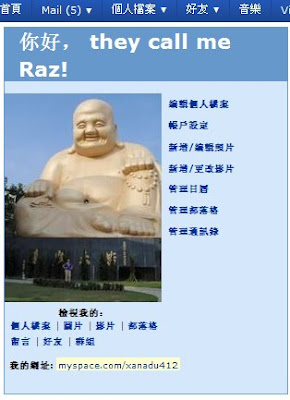
One of the things that I have to deal with here is that a lot of Internet pages think that because I'm logging on from Taiwan, my preference would be to see their website in Chinese. [ok, this is a logical assumption]

The good thing is that when this happens, it is typically very easy to find a button that said "English" and translate the page back into my own language... But there are two VERY noticeable exceptions to this that I encounter in my daily life: Facebook and Myspace!

This is very annoying! Neither site takes into account that I'm logging on with an account registered in the US that I have been accessing for years in English, and now both of the pages load in Chinese with no apparent way for me to change them into English. These are literally the only two websites I have found in the last two months that don't have a button to change them into English... it just doesn't make any sense!!!

It hasn't been toooooooooo much of a hassle (fortunately I'm so familiar with both sites that I can find my way around without English) but it's pretty damn annoying.

So when I log onto Myspace, this is what my page looks like:


And my Facebook page looks similar...
Ahhhhhhhhhhhhhhhhhhhhhhhhhhhhhhhh

Monday, March 23, 2009

I'll take a clock on my sandwich....

So, I've been going to Chinese classes for a couple of weeks now and little by little I'm gaining the confidence to try to speak Chinese in my daily life.


You would think it would be easy for me to practice my Chinese, since I'm living in Taiwan and all, but most of the people I come into regular contact with speak more English than I speak Chinese, so it often just makes sense for me to speak in English. This is also in addition to the fact that my pronunciation is soooooooo lousy most people can't understand me when I do decide to speak Chinese. This morning, however, I was feeling particularly ambitious:

Nick and I were at the breakfast place that we patronize about 3-4 times a week. The owner doesn't speak any English, but we found something we like on the menu and order the same thing every morning: a ham sandwich (on delicious french-style bread, toasted) with a hard boiled egg, some jello, and a coffee.

Nick typically cuts his hard-boiled egg in half and puts it on his sandwich and many mornings I think about how much better the sandwich would be if it had a fried egg in it. So today, I thought I'd ask him to fry the egg and put it on the sandwich.... let's just it wasn't as easy as I had hoped.

Earlier in the morning, my Chinese teacher gave me a vocabulary list of different food items. With this list, I now knew how to say fried. I already knew how to say egg and sandwich, so I figured I was armed and ready.

So I walked up to the counter, ordered my regular breakfast and said, "women yao zhege ji dian chao on zhege san ming che" which I thought meant "we want the egg fried on the sandwich."

He didn't quite understand me, so I kept repeating ji dian, ji dian.... and after much confusion he finally he picked up an egg and pointed to it, conveying the message "is this what you mean?" We agreed that yes, I am trying to discuss the egg, and so he clarified the pronunciation for me "ji dan" he said.

And then it clicked... I had been saying ji dian (幾點) which means "what time is it?" and not ji dan (雞蛋) which means egg.

So I had basically said "we want the what time is it fried on the sandwich" and that is BEST case scenario - if I managed to say all of the other words in the sentence correctly....

Thankfully, through some basic hand gestures, he did finally understand what I wanted and - I must say - the sandwich was delicious. It was a small victory for Nick and I but; unfortunately, it was in no way thanks to my mastery of the Chinese language. I guess I'll just have to keep practicing!

Thursday, March 19, 2009

Nick and I Have the Same Last Name!!

ok ok ok, don't freak out! We didn't do anything crazy like get hitched in Taiwan!

Since we are now living in a Chinese-speaking country, we need to have our own Chinese names. It just so happens, that since both of our last names start with S, we have been given the same Chinese surname.

In Chinese, your last name - surname or family name - comes first and your first name - given name - comes last. So, for example, the English name John Smith in a Chinese format would be Smith John.

Keeping that in mind, here is my new Chinese name:
史瑞秋
The first character is the surname that both Nick and I share, pronounced "shi"

The second two characters were chosen because their sounds closely resemble my English name:
(pinyin: Rui) is pronounced like "ray"
(pinyin: Qiu) is pronounced kind of like "chio"
So together it sounds like Ray-Chio... pretty close!

Nick's name is also sounds pretty similar to his English name:

史尼克

Again, his surname is pronounced "Shi"

His first name is made up of two characters:
(pinyin: Ni) is pronounced like "knee"
(pinyin: ke) is pronounced "kuh"
So together, his Chinese name is "Knee-Kuh"

Pretty cool, huh?

Friday, March 6, 2009

BoPoMoFo

Have you ever thought to yourself "how the hell do Chinese people type on the computer!"

Well, before coming here, I had often wondered that... and so I thought I might as well share the answer with you. First, let's go over some basics of learning Chinese.

There are a couple of ways to learn Chinese, one is with Pinyin. Pinyin is a system of romanization the Chinese language using a form of the English alphabet. The system helps people phonetically learn how characters and words sound. For example the character for "I" () is spelled "wo" in pinyin. This is the way I learned Chinese when I was at Penn State.

Pinyin is also used to "Romanize" street signs here in Taiwan and other places where Chinese is used. So when I see a street sign, I can figure out how it is pronounced (kind of... but more on that later!)

However, for people who don't come from a country that uses the roman-based alphabet, there is another phonetic alphabet used for those learning Chinese. (this is the system used by Taiwanese children - children in mainland China actually learn pinyin). These Mandarin Phonetic Symbols are colloquially referred to as "bopomofo" (just like the English alphabet is called the ABC's). Here are the first four "letters" :
I just had my first Chinese class this morning at Feng Chia University and am now working on memorizing the Bopomofo alphabet (which has 37 characters). One advantage of this system is that because it does not use romanization, confusion over "Latin alphabet" sounds and "Chinese" sounds is not a problem.

In Taiwan children's books are written with this alphabet as a way to allow them to read before they have started learning characters. This alphabet is also used in the dictionary to show the phonetics of characters:


Although I've never seen the above characters before, I can tell you (based on what I learned in class today) that these two characters are "Fu" and "Hao." It's a pretty nifty system.

So, how do they type? Well they use on of these (or any other available romanization) systems to spell how the word sounds. People with standard US keyboards will typically use Pinyin to type Chinese. So when I type the word "wo" the character 我 will pop up. In this sense, it is a lot like predictive text-messaging input. The most common character will come up first and if that is not the correct character, you can just select the right character from an available list.

Native Chinese speakers, or anyone else who learned Chinese with the bopomofo system, also use a QWERTY keyboard with some extra symbols on it.

Input is similar, you spell the Chinese word and characters pop up for you to choose from. This is actually not the only way to type in Chinese, but the other system is a similar I believe.

So... there you go. I hope that wasn't too confusing!

Anyway, I guess I should get back to studying and stop procrastinating!